
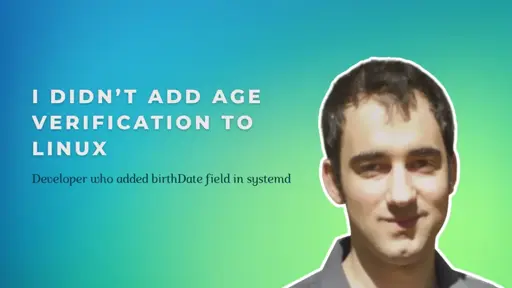
Dylan M. Taylor is not a household name in the Linux world. At least, he wasn’t until recently.

The software engineer and longtime open source contributor has quietly built a respectable track record over the years: writing Python code for the Arch Linux installer, maintaining packages for NixOS, and contributing CI/CD pipelines to various FOSS projects.

But a recent change he made to systemd has pushed him into the spotlight, along with a wave of intense debate.

At the center of the controversy is a seemingly simple addition Dylan made: an optional birthDate field in systemd’s user database.

  • Vogi@piefed.social
    link
    fedilink
    English
    arrow-up
    12
    arrow-down
    10
    ·
    1 day ago

    Being on Linux and in control of your OS couldn’t you just set the age statically to something like 99? I really do not understand the hate :/

    • uuj8za@piefed.social
      link
      fedilink
      English
      arrow-up
      29
      arrow-down
      1
      ·
      1 day ago

      I really do not understand the hate :/

      The itsfoss interviewer goes into this:

      A lot of backlash isn’t about the code change, but about what it represents.

      You say this is “just attestation, not verification” but we know that infrastructure always gets repurposed later. This is where the legit fear lies.

      Do you think regulations like these will reshape desktop Linux in the next 5-10 years where we might have “compliant Linux” and “Freedom-first Linux”?

      Sam Bent’s article also goes into this (although, fuck that clickbait title): https://www.sambent.com/the-engineer-who-tried-to-put-age-verification-into-linux-5/

      He read the laws, decided compliance was the correct response, and went to work. Every objection the community raised went nowhere: that this enables surveillance infrastructure, that lying is trivially easy, that the laws themselves are unconstitutional overreach. He’d already accepted the law as legitimate and moved to implementation.

      He read the law, took it at face value, and started writing code. The word for what that is sits somewhere past malice, something more insidious: an engineer who treats compliance as engineering, who sees a legal requirement the way he sees a technical specification, and will implement whatever the spec says regardless of who wrote the spec or why.

      The reason to name him is the pattern. The surveillance state runs on volunteers: people who do the implementation work for free, out of genuine conviction, with no paper trail connecting them to the money that wrote the laws.