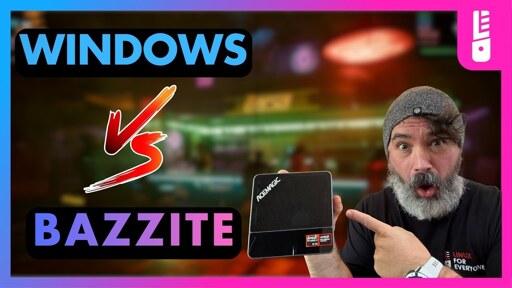
👉 ACEMAGIC F5A Mini PCs @ Amazon: https://amzn.to/4kbhRloI'm currently reviewing the ACEMAGIC F5A Mini PC which ships with Radeon 890M integrated graphics. ...
Hah. I spent more time writing this post in the gaps between waiting for work stuff to finish work stuffing. I can’t just… not sit down for work for an arbitrary amount of time because I’m busy arguing with the Linux Nvidia drivers.
I agree that’s the point of Bazzite, though. So if it doesn’t in fact “just work” for me, then what’s the point of it?
If you just want to boot whatever you were running prior to the last update, yeah, it’s typically in the GRUB menu. If you updated more than once (which I believe I did) you need to go find the previous snapshot, but it’s not too much more hassle.
That doesn’t particularly fix anything, though, unless you’re cool with not updating indefinitely the thing you wanted to use or with updating everything else manually until the issue is fixed. If you want to be able to fix the update you still have to go into the logs and figure out what’s going on (since the failure isn’t universal and I know people are running these drivers without issues this must be possible). And of course all that assumes it was actually the update that broke something and the rollback actually fixes the issue.
Or, hear me out, I could reboot and choose Windows in GRUB instead, and that works for sure and I don’t have to think about it.
So Windows it is until I feel adventurous. I owe my Bazzite install zero extra time. If it can’t run as conveniently as clicking down one more time to select Windows then it’s not running.
As I said elsewhere, people really underestimate the level of stability it takes to be a mainstream option for a desktop OS.
I’m not saying it’s okay for Bazzite to have shipped a broken update. That’s sloppy.
But you really are being a dumbass here. The solution for your problem is a rollback. That’s the whole point of atomic distros: rollback when something breaks using a single command (or just reboot and pick the grub option). Why bother with atomic if you’re not going to use one of the killer features?
And in case you didn’t know, Flatpaks aren’t part of your OS, so you can still do flatpak update even if you don’t update Bazzite. There is literally zero cost to doing a rollback, and that’s by design.
It’s probably worse than it’s been, less bad than people around here think.
One thing MS does is they have a TON of silent channels and branches, so every release they do is a rolling release. As a result, when you see in the news that they fucked up again and messed up a bunch of something somewhere it tends to be relatively contained still. I think the latest was a bad patch breaking a bunch of stuff that required a couple of emergency patches and I think there may be more to go.
It’s 100% not good, and it almost certainly affected a lot of machines, but it probably got stopped from spreading further. If they had a signed driver update break their entire desktop interface in an update sent to every user they’d be (rightfully) crucified endlessly.
I get that there is a massive discrepancy of resources at play, but that doesn’t make it better from the end user perspective. I’ve been saying for years that the Linux community keeps saying that “you can choose the distro you like” is a feature, but it isn’t. Desktop Linux should be one thing. A couple, max. Contributions should be way more centralized and pool resources, like they are on the kernel. Distro choice is an anti-feature and a massive waste of resources.


Hah. I spent more time writing this post in the gaps between waiting for work stuff to finish work stuffing. I can’t just… not sit down for work for an arbitrary amount of time because I’m busy arguing with the Linux Nvidia drivers.
I agree that’s the point of Bazzite, though. So if it doesn’t in fact “just work” for me, then what’s the point of it?
You literally just reboot and pick the older image on boot, if it’s anything like Aurora.
If you just want to boot whatever you were running prior to the last update, yeah, it’s typically in the GRUB menu. If you updated more than once (which I believe I did) you need to go find the previous snapshot, but it’s not too much more hassle.
That doesn’t particularly fix anything, though, unless you’re cool with not updating indefinitely the thing you wanted to use or with updating everything else manually until the issue is fixed. If you want to be able to fix the update you still have to go into the logs and figure out what’s going on (since the failure isn’t universal and I know people are running these drivers without issues this must be possible). And of course all that assumes it was actually the update that broke something and the rollback actually fixes the issue.
Or, hear me out, I could reboot and choose Windows in GRUB instead, and that works for sure and I don’t have to think about it.
So Windows it is until I feel adventurous. I owe my Bazzite install zero extra time. If it can’t run as conveniently as clicking down one more time to select Windows then it’s not running.
As I said elsewhere, people really underestimate the level of stability it takes to be a mainstream option for a desktop OS.
I’m not saying it’s okay for Bazzite to have shipped a broken update. That’s sloppy.
But you really are being a dumbass here. The solution for your problem is a rollback. That’s the whole point of atomic distros: rollback when something breaks using a single command (or just reboot and pick the grub option). Why bother with atomic if you’re not going to use one of the killer features?
And in case you didn’t know, Flatpaks aren’t part of your OS, so you can still do
flatpak updateeven if you don’t update Bazzite. There is literally zero cost to doing a rollback, and that’s by design.Fair enough. Although I wouldn’t call Windows 11 stable, nowadays.
It’s probably worse than it’s been, less bad than people around here think.
One thing MS does is they have a TON of silent channels and branches, so every release they do is a rolling release. As a result, when you see in the news that they fucked up again and messed up a bunch of something somewhere it tends to be relatively contained still. I think the latest was a bad patch breaking a bunch of stuff that required a couple of emergency patches and I think there may be more to go.
It’s 100% not good, and it almost certainly affected a lot of machines, but it probably got stopped from spreading further. If they had a signed driver update break their entire desktop interface in an update sent to every user they’d be (rightfully) crucified endlessly.
I get that there is a massive discrepancy of resources at play, but that doesn’t make it better from the end user perspective. I’ve been saying for years that the Linux community keeps saying that “you can choose the distro you like” is a feature, but it isn’t. Desktop Linux should be one thing. A couple, max. Contributions should be way more centralized and pool resources, like they are on the kernel. Distro choice is an anti-feature and a massive waste of resources.