

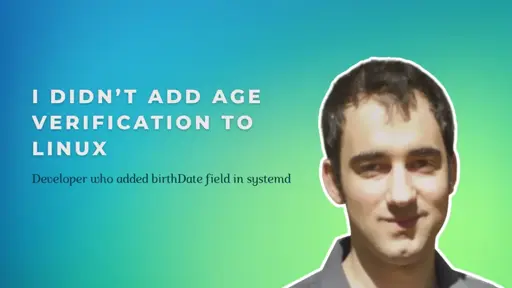
Dylan M. Taylor is not a household name in the Linux world. At least, he wasn’t until recently.
The software engineer and longtime open source contributor has quietly built a respectable track record over the years: writing Python code for the Arch Linux installer, maintaining packages for NixOS, and contributing CI/CD pipelines to various FOSS projects.
But a recent change he made to systemd has pushed him into the spotlight, along with a wave of intense debate.
At the center of the controversy is a seemingly simple addition Dylan made: an optional birthDate field in systemd’s user database.
He didn’t apply the change, he proposed it.
And there’s zero surveillance in the change he proposed.
If we are going to get stuck in semantics, then he also did not just propose it. Propose would be opening an issue, describing how he would plan to do it and letting people discuss. This is how proposals work. Pushing a very controversial change and getting someone to accept it is not “proposing” when the change is something the community will obviously be so divided over.
And it does not have to implement a full on surveillance mechanism to take a step towards better compliance with possible future surveillance laws. The guy literally said in his comments that this was the intent:
https://github.com/archlinux/archinstall/pull/4290
What the hell are we even discussing here?
A pull request is very much a proposal: It is a proposal to make specific changes to the code-base. The developers are not forced to accept it in any form, and discussions can take place in the pull request, should the developers (or third parties) not agree with (the exact form of) the proposed changes. Which is exactly what happened in the systemd pull request, to the extent that the actual developers had to lock the thread.
In the case of systemd, the “someone”, or rather the “someones”, who accepted the pull request also included the lead developer on the project, namely Lennart Poettering. Who else do you propose should decide what pull requests and other proposals to accept?
You’re approaching this with an everyday definition of “proposal”, but in the industry that term is overloaded with more specific meanings.
If you asked 100 random devs, I have no doubt that the majority would call a PR to be something much more concrete than a proposal.
Simply not true. In any such project, major proposals first get discussed as issues and community either vets a plan or comes up with an alternative before more solid steps such as PRs start. What is being done here is clearly trying to downplay a major change as a minor one. There are loads of blog posts and discussions on why this isn’t a minor change, especially when the author of the PR himself admits the goal is to comply with age verification laws. I will not get into that here. Suffice to say, at best, this is a political statement of the kind “we are ok to comply with surveillance and will show minimal resistance”. Yet they try to play this as if they are just changing a typo in the documents. Thanks to Lennart for his life long contributions to FOSS, despite him at some point joining Microsoft, the antithesis of everything that is FOSS. I am sure many things he did shaped how the open-source developed on a world-wide level. This still does not mean that his reaction to everything will be correct. To me this was more like a “fuck all, this was a minor change, don’t care what you say” attitude, which in my world-view has place in propriety software world not FOSS.