

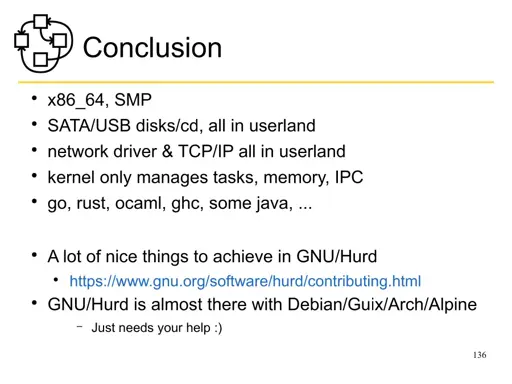
Samuel Thibault offered up a status update on the current state of GNU/Hurd from a presentation in Brussels at FOSDEM 2026. Thibault has previously shared updates on GNU Hurd from the annual FOSDEM event while this year’s was a bit more optimistic thanks to recent driver progress and more software now successfully building for Hurd.
GNU/Hurd continues to lag behind the Linux kernel and other modern platforms for hardware driver support. But driver support for Hurd has been improving thanks to NetBSD’s rump layer.
It seems x86_64 is finished, the article cites that too:
Now it’s arm64.
I’m more hopeful, I wrote a very basic userland thread scheduler in rust, like tokio, for full virtual threading (yielding instead of blocking), from a Java Virtual Thread inspiration and damn, the performance is amazing, just changing kernel scheduling to userland scheduling. I think Hurd would be the perfect kernel for that kind of next generation performance bump, a global scheduler with userland virtual processes and virtual threads. A microkernel has some advantages that weren’t event thought if not for recent developments, imagine what it could do, docker, kubernetes, podman, (the containers, not the engines) all inside subhurds or virtualized in a thin layer without cgroups or anything.
I think it’s the future, but it’s the future since the 80s hahaha.
Edit: the virtual thread scheduler is just a toy project, but I was impressed.
I think microkernel’s are weird but everything I hear does seem to imply they are better then what we currently have. That being said, “microkernel’s are the future” is a pretty old take now and I don’t know any OS that has one.
Linux is monolithic. Windows is somehow monolithic, bloated and extremely minimal. Don’t know about apple but I would guess they’re also monolithic since they are old and Unix based and that combination generally means monolithic.
MacOS’ XNU kernel is derived from the Mach microkernel, the same one on which Hurd is built. (Or at least approximately the same, since apparently there were various editions of Mach.)
Look at my other comment, there’s something cooking at GNU, idk but i’m hyped. I think Windows and MacOS (darwin/XNU) are hybrids, some parts in userspace, other parts in the kernel.
Edit: the macos kernel
I just discovered pth (not the new one npth), yielding threads in 1999, wtf happens at GNU? 20 years before anyone applied that and said “holy shit”. 1999.
Edit:
1999