

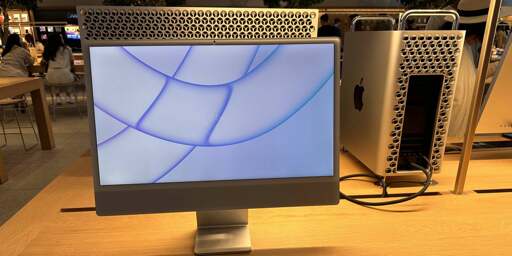
Apple has discontinued the Mac Pro – but it’s just the first of the tower computers to go. The rest will follow soon.
Fruit-sniffers extraordaire 9-to-5 Mac got the news yesterday, complete with official confirmation from Apple itself. It’s official and it’s happened, but there have been warning signs for months – in November 2025, Bloomberg’s Matt Gurman said “The Mac Pro is on the back burner.”
The phantom fruit-flingers of Silicon Valley launched the seven-thousand-buck Apple Silicon-based Mac Pro in June 2023, with an M2 Ultra SoC. It sported seven PCIe slots – but the problem was that cash-rich customers couldn’t add the sorts of expansion that normally go into a PCIe slot… to the extent that Apple publishes a page about PCIe cards you can install in your Mac Pro (2023). Notably, the machine did not support add-on GPUs: only the GPU that’s integrated into the CPU complex along with the machine’s RAM and primary flash storage. The machine also had no RAM expansion whatsoever.
Presumably, this limited its appeal for many traditional buyers, and the machine never saw an M3 or M4 model, let alone the M5 SoC that The Register covered shortly before Bloomberg called the Arm64 cheesegrater’s fate.
Honestly I’m shocked desktop PCs have lasted this long.
That being said, PC gaming is a growing trend, not shrinking, so I suspect there will continue to be at least some availability in the future for those components?
Additionally, while Macs are really great at some workloads, they’re still inferior in others to existing desktop machines with dedicated GPUs, and the closest competitor from Apple will still cost at least twice as much.
Wait until we see the 2026 stats for hardware sales. 📉
Though I think the supply issues will hurt consoles just as much.
I’m not sold that modular desktops are going away in general. SoCs have some benefits in terms of power usage, but those are most-substantial on phones and least-substantial on the desktop.
My understanding is that memory may move away from DIMMs to CAMM2 to permit for higher speeds, but that’s still a modular system.
Yes. That Apple can do these things because their soc is their market deferential. It’s not an over all market direction.
CAMM has been around for years now but I’ve never seen a single model using them. Even Framework passed on them with their new desktop.
You don’t need to as long as you’re getting sufficient speeds from non-soldered DIMMs, and desktops are generally still using non-soldered DIMMs.
Desktop PCs are so much more powerful and fast than laptops of the same spec. Not to mention cheaper.
High integration on laptops decreases space and cost by wildly increasing battery life for the same battery
This isn’t about laptop/desktop but about modular vs. Integrated processors.
Integrated processors let laptops be faster without also using power. Strictly speaking it’d be cheaper to just use a faster CPU but battery life is more important than cost so lots of money is spent on integrating processors.
Desktops are still around because they’re upgradable and faster than their laptop brothers.
…once again, not talking about laptops.
An AIO is effectively a laptop without a keyboard. They’re functionally very similar (appealing to less power-hungry users). They’re just less mobile.
Presumably it’s cheaper for apple to just put the integrated CPUs in everything because it’d be expensive to make another model.
I garuntee you this trade off only makes sense for Apple. Other AIOs don’t always have the new laptop chips from Intel because it makes more sense to use the desktop one with all the space they have.
They put them in everything because they’re smaller and more efficient (and thus quieter) and because they’re competitive with PC desktops in performance. And economies of scale doesn’t hurt either.
I get what you mean. What I’m trying to say is that desktop/non integrated CPUs are cheaper and this cost savings continues into a large form factor. Apple doesn’t put a desktop chip in their iMacs because they don’t make one. That’s not what their customer base needs. If they did it’d be 4x faster for the same price.
And these arm chips are slower than x86. X86 is so much faster at least for single core performance which matters a LOT more for desktop use cases
Again, it depends on the workload. There are endless comparisons between high end desktops and comparably-priced Mac desktops, and while the PC is often more powerful, that’s not always the case , and the Mac does it while being much quieter, and not turning the room it’s in into a sauna.