@ColdWater that and probably the Microsoft root certificate stored in your motherboard’s firmware
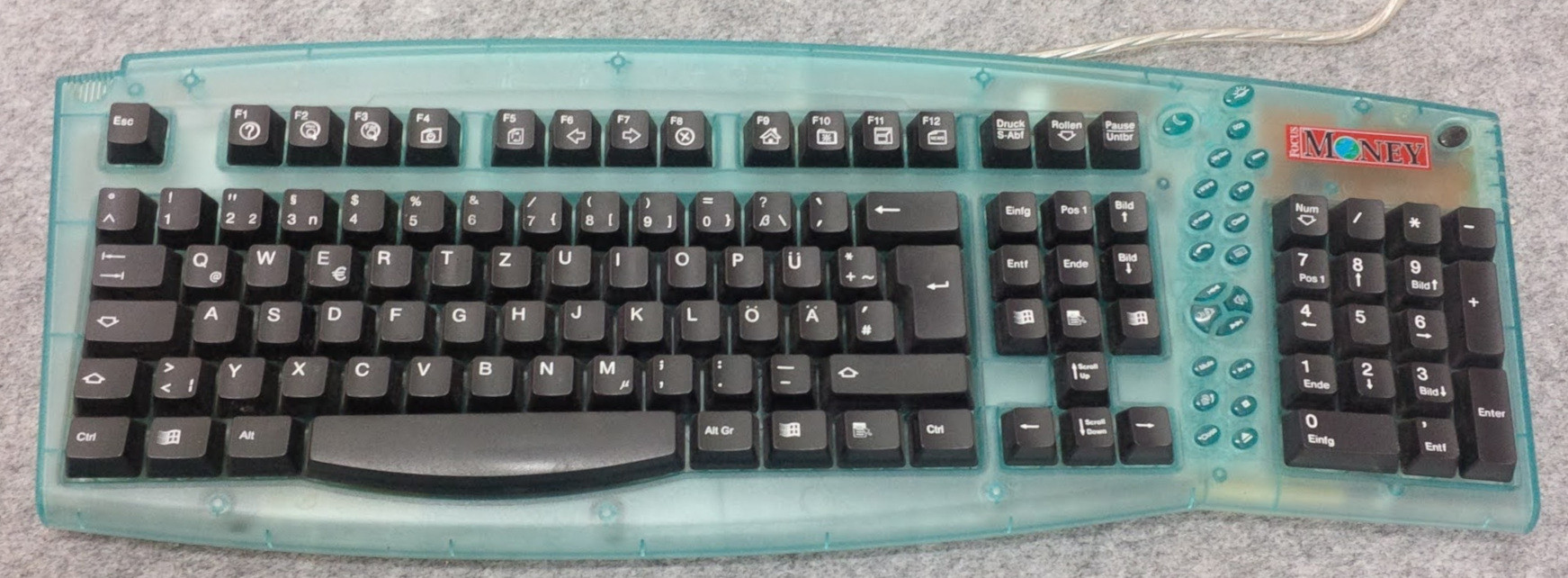
I used to have this really awesome early 2000’s transparent blue plastic keyboard with all the newest media keys. The only problem was that it had 4 windows keys on it! One on either side of the spacebar. The right side of the spacebar was Alt, Windows, Context menu, CTRL. That was a bit weird but it was alright. The next placements were crazy though. Someone figured there was space for more keys right below the Delete, End and Page Down keys but I guess they couldn’t really figure out what would be best for there so they put a 3rd Windows key, a 2nd Context Menu and then a 4th Windows key right there. This was pretty close to the arrow keys and if anyone remembers gaming in the early 2000’s, pressing the windows key accidentlly would often just crash your game completely. If you could get back into it, it could take quite a while for it to respond again. So if you were playing something like Warcraft 2 multiplayer, that button was a fucking nightmare.
Ugh, I loved the colour of that keyboard so much I put up with all those windows keys.
edit: I can’t believe I found it! I’ve tried searching for this keyboard a few times, but finally found proof on this site!
I submitted the mysterious extra
nsituation on military keyboards as a question for Lateral and they featured it in today’s episode!Spotify video • Spotify CDN raw file (34:18) • catbox.moe • Podverse.fm clip • Website with transcript
They reserve the right to edit questions and omitted the important
n-lock key. A keyboard with a permanently missing 3 would be ridiculous.Edit: Now it’s also a highlight on YouTube, their second-most-viewed last year, but they didn’t attribute the question to me there, not even in text
Do you know why the
3key has ann? I have a hunch:
This is clearly a tactical keyboard for use in military, aviation or maritime navigation systems! /s
Now I gotta know the tactical reason for the 2 key to also have the 2 symbol?
I did’t know much about the German keyboard layout but I know the Czech one, which is derived from it (we both use QWERTZ) and was able to look up most of what I didn’t know.
So, the keyboard has 4 layers: default, Shift, AltGr, AltGr+Shift (the fourth one is not standard but is recognized by xkb; in Czech I use it for custom character mappings, in German it is standardized but Linux-only).
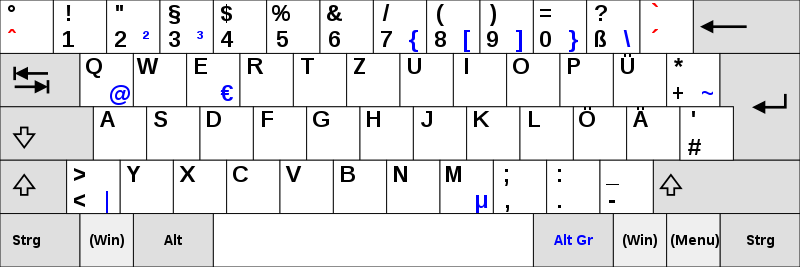
- Default layer prints lowercase letters a-z and äöüß, numbers and the symbols in the lower-left of each key.
- Shift layer prints uppercase letters A-Z and ÄÖÜ and symbols at the top left of each key.
- Caps Lock only affects letters. I don’t know what happens when you press ß with Caps Lock on a system too old to know about ẞ (only in Unicode since 2008, and “allowed” in German since 2017) and I don’t want to make vintage computers explode at 39c3.
- AltGr layer prints lower-right symbols, most of which are only populated in a later version of the layout.
- AltGr+Shift (Linux only) prints upper-right symbols.
As you can see, AltGr+2 produces ², and AltGr+3 produces ³. I think the full-size “2” and “n” are misprints. My old Czech keyboard has some errors too.
By the way, Czech is more chaotic:
- we have lots more diacritics so the number row only prints numbers on its Shift layer (most people therefore use the numpad only)
- to print rare diacritics (ó, ď, ť, ň, and German ä, ö, ü), one has to first press the corresponding modifier key (
´,ˇ,˚,¨) like on typewriters- an alternative for common capital diacritics (á, é, ě, í, ú, ů, ý, ž, š, č, ř) is to briefly turn on Caps Lock (advantage over typewriters)
- pressing the
˚key twice prints the degree sign (°) twice (Windows) or once (Linux)
- there is a bloody dedicated
§key but we need to press AltGr+7 twice, then backspace (or Alt+96) for a grave (`), which is part of ASCII and used in Markdown - physical keyboards almost always reserve the right side of the keys for the English-US layout (very confusing for novices) so one has to type in the AltGr layer blind (except for
€); it contains useful symbols ([]{}<>|\€$@#^&×÷`) as well as useless ones (Đđ – these are Slovene, why not the Slovak Ôô?), leading people to prefer Windows-only left-Alt+numpad codes (such as Alt+64 for @) that use the obsolete OEM-1252 codepage (the Unicode extension has to be enabled via registry and Alt+letters hex codes get passed to programs anyway, often defocusing the input element). I only found a Slovak one on Wikimedia Commons - some lazy manufacturers combine the Czech/English and Slovak/English layouts, which are similar except ľ, ť and ô, leading to 5 (!) symbols per key, 3 of which are irrelevant unless you switch layouts
- Gboard for Android offers QWERTY for Czech, which looks normal (hold for diacritics, potentially swipe for ě and ů) and the unpopular QWERTZ-PC, which has all the physical keyboard’s quirks, but its “Czech QWERTZ” is based off German QWERTZ, containing ú and ů but not the other diacritics for some reason. All other keyboard apps with Czech language layout get this right (hold for diacritics, potentially swipe for ě and ů)!