People did this with newspapers back in the day. With headphones before Bluetooth took over. With books.
It’s not a new phenomenon. Not everyone needs to have small social interactions every moment of the day or even most moments.
We live in a way more connected world than we ever have before and people do not take enough time to themselves because they are always reachable always “on”. So especially when you live in an urban environment and take public transit or similar that time you spend there listening to music or a podcast or just shutting out the world can also be healthy.
I question how they controlled for this and if the headphones use is the actual problem or if they are isolating for other reasons and the headphones are a symptom.
I think you are missing the point the author is making, they explicitly state there is nothing new about blocking out social interaction while on public transport or while sat at a cafe.
But the difference they are commenting on is people having headphones in all the time while ordering your coffee at the cafe or while playing a round of golf (as their examples) that isnt normal. You would have been considered incredibly rude if you walked up to a counter to order and didnt take your eyes off the newspaper you were reading.
Did people ever take off their headphones to order coffee? I remember many people wearing wired earphones full time. You can’t compare it to a newspaper as reading requires your full attention. Music is just on the background, it shouldn’t impede communication unless it’s too loud.
Womble got it. The point is the use of earbuds, specifically, at all times. Not even taking them out to order a coffee, buy a book, or any other small interaction. That’s a big shift made easier, I think, because they are tiny and you’ve got a pause button (if used). They’re less an escape than an extension of one self at that point.
So, a couple of things someone else brought up in another comment in this thread is the fact that fairly often, Neurodivergent people who are just now receiving products and strategies to help them curate the world around them so they can function better in it very often did do this. Some of them are probably like me in that there’s a feeling of pressure that helps them regulate and the lessened expectations for social norms when they are in.
I agree neurotypical people have taken that and sort of co-opted it (because airpods are a status symbol if for no other reason), and now it’s become more socially acceptable.
But I’m probably not a good judge of the kinds of interactions they’re missing because I literally don’t do that. I can’t function that way without heavily masking and it’s exhausting for me.
But then I also wonder if it is just neurotypicals doing that. There are so many more people being diagnosed with Neurodivergent conditions like ADHD, autism, schizophrenia, clinical anxiety, etc and I wonder if that has a lot to do with it.
But the loneliness thing I think could potentially b a separate issue with a lot of overlap and so I’m trying to factor all that together and read the article through that lens.
There’s a generation of people who have been broken by retail on both sides. Retail workers who are burnt out on interacting with people because so many of them are just rude or antagonistic in general, and people who are used to buying things onlin or receiving a specific “quality” of service that they hold as the standard for everyone and when you add to that the lack of third spaces and rising costs I just think there more to it than “I wear earbuds so I don’t have to make small talk with the barista while they make my latte”.
There is a distinct possibility that I am wrong just because this isn’t my wheel house. Those kinds of interactions make it really hard for me to function and so I avoid them at all costs.
I’m not quite sure how to answer. But I want to dive into the statistical side of things to try to convey how I’m viewing this and trying to explain why it’s an important observation.
Use cases for neurodivergency are outliers in the statistical sense here. You and I wearing airpods because its an aid to survive our day is a statistical insignificance compared to the population at large. This does not negate the relief nor wonder such relief brings. Instead, it sets the stage to look at the statistically significant population that otherwise does not need the aid to function daily. Then we can observe and comment on the changes that dictate social interactions and human experiences that, until now, were relatively stable and predictable. You got to the Barista, closed your book or took off your headphones, and ordered your coffee. Now many don’t interrupt their music at all. The ordering is background noise, the human to human social interaction a nuisance at worst, an interruption at best.
In this framing, a population no longer interacts with the world and each other the way they used to prior to the technological changes. Which begs a few questions all starting with why. There is a new social phenomenon here that we don’t understand. To use the newspaper on the train analogy, people are taking the newspaper with them through the station, up the stairs, to the cafe, into work, working, and only glancing up and away to conduct an interaction before going right back into the print.
In short, the barrier between personal bubble and public interaction changed. Personal space is more nebulous and obscures, or superceds (I’m not quite sure how to define it), public interactions to the degree that a brief social encounter, once normal, is now abnormal and something leaning towards one sided and purely transactional. That must have profound implications for human behavior. Not to mention human and environment interactions.
You change how > 95% of the world acts, its going to effect everyone.


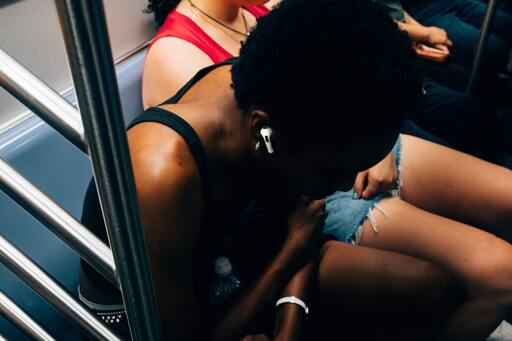
People did this with newspapers back in the day. With headphones before Bluetooth took over. With books.
It’s not a new phenomenon. Not everyone needs to have small social interactions every moment of the day or even most moments.
We live in a way more connected world than we ever have before and people do not take enough time to themselves because they are always reachable always “on”. So especially when you live in an urban environment and take public transit or similar that time you spend there listening to music or a podcast or just shutting out the world can also be healthy.
I question how they controlled for this and if the headphones use is the actual problem or if they are isolating for other reasons and the headphones are a symptom.
I think you are missing the point the author is making, they explicitly state there is nothing new about blocking out social interaction while on public transport or while sat at a cafe.
But the difference they are commenting on is people having headphones in all the time while ordering your coffee at the cafe or while playing a round of golf (as their examples) that isnt normal. You would have been considered incredibly rude if you walked up to a counter to order and didnt take your eyes off the newspaper you were reading.
Did people ever take off their headphones to order coffee? I remember many people wearing wired earphones full time. You can’t compare it to a newspaper as reading requires your full attention. Music is just on the background, it shouldn’t impede communication unless it’s too loud.
Womble got it. The point is the use of earbuds, specifically, at all times. Not even taking them out to order a coffee, buy a book, or any other small interaction. That’s a big shift made easier, I think, because they are tiny and you’ve got a pause button (if used). They’re less an escape than an extension of one self at that point.
So, a couple of things someone else brought up in another comment in this thread is the fact that fairly often, Neurodivergent people who are just now receiving products and strategies to help them curate the world around them so they can function better in it very often did do this. Some of them are probably like me in that there’s a feeling of pressure that helps them regulate and the lessened expectations for social norms when they are in.
I agree neurotypical people have taken that and sort of co-opted it (because airpods are a status symbol if for no other reason), and now it’s become more socially acceptable.
But I’m probably not a good judge of the kinds of interactions they’re missing because I literally don’t do that. I can’t function that way without heavily masking and it’s exhausting for me.
But then I also wonder if it is just neurotypicals doing that. There are so many more people being diagnosed with Neurodivergent conditions like ADHD, autism, schizophrenia, clinical anxiety, etc and I wonder if that has a lot to do with it.
But the loneliness thing I think could potentially b a separate issue with a lot of overlap and so I’m trying to factor all that together and read the article through that lens.
There’s a generation of people who have been broken by retail on both sides. Retail workers who are burnt out on interacting with people because so many of them are just rude or antagonistic in general, and people who are used to buying things onlin or receiving a specific “quality” of service that they hold as the standard for everyone and when you add to that the lack of third spaces and rising costs I just think there more to it than “I wear earbuds so I don’t have to make small talk with the barista while they make my latte”.
There is a distinct possibility that I am wrong just because this isn’t my wheel house. Those kinds of interactions make it really hard for me to function and so I avoid them at all costs.
I’m not quite sure how to answer. But I want to dive into the statistical side of things to try to convey how I’m viewing this and trying to explain why it’s an important observation.
Use cases for neurodivergency are outliers in the statistical sense here. You and I wearing airpods because its an aid to survive our day is a statistical insignificance compared to the population at large. This does not negate the relief nor wonder such relief brings. Instead, it sets the stage to look at the statistically significant population that otherwise does not need the aid to function daily. Then we can observe and comment on the changes that dictate social interactions and human experiences that, until now, were relatively stable and predictable. You got to the Barista, closed your book or took off your headphones, and ordered your coffee. Now many don’t interrupt their music at all. The ordering is background noise, the human to human social interaction a nuisance at worst, an interruption at best.
In this framing, a population no longer interacts with the world and each other the way they used to prior to the technological changes. Which begs a few questions all starting with why. There is a new social phenomenon here that we don’t understand. To use the newspaper on the train analogy, people are taking the newspaper with them through the station, up the stairs, to the cafe, into work, working, and only glancing up and away to conduct an interaction before going right back into the print.
In short, the barrier between personal bubble and public interaction changed. Personal space is more nebulous and obscures, or superceds (I’m not quite sure how to define it), public interactions to the degree that a brief social encounter, once normal, is now abnormal and something leaning towards one sided and purely transactional. That must have profound implications for human behavior. Not to mention human and environment interactions.
You change how > 95% of the world acts, its going to effect everyone.